Linda Ouhbi 01/2020 Hand-Built Stoneware Vase (14in/35cm)
US$3,270

Linda Ouhbi 01/2020 Hand-Built Stoneware Vase (14in/35cm)
US$3,270
7,000+ products IN STOCK and READY TO SHIP
7,000+ products IN STOCK and READY TO SHIP


Curiosity, intrigue, and a forever obsession with proportion are non-negotiables in architect and interior designer Steven Gambrel’s creative playbook. Famed for his award-winning projects spanning town, country, mountain, beach, and boats over the past three decades, the AD100 designer’s approach relies on rooms as fully fleshed out environments that are as locked into the character of their location as they are to the occupants. Here, he shares his relationship with design, including why nostalgia belongs in the past, how heirlooms need rethinking, and what makes imperfections important.
Curiosity, intrigue, and a forever obsession with proportion are non-negotiables in architect and interior designer Steven Gambrel’s creative playbook. Famed for his award-winning projects spanning town, country, mountain, beach, and boats over the past three decades, the AD100 designer’s approach relies on rooms as fully fleshed out environments that are as locked into the character of their location as they are to the occupants. Here, he shares his relationship with design, including why nostalgia belongs in the past, how heirlooms need rethinking, and what makes imperfections important.

What role does design play in your life?
“I get a huge amount of pleasure from living with design, sleeping in it, and waking up to remarkable things. By remarkable, I don’t mean out of the norm or valuable—it can be as simple as the way light hits an object or surface. I would find it difficult to wake up in a soulless environment that lacked consideration.”
What is it about the creative process that draws you into working within design?
“I received a delightful text last night from a client from a project I’m working on in Charleston—a 19th-century house in Mount Pleasant that we rebuilt—saying how much pleasure it gives her knowing how many people will be affected positively by visiting the house. She said the people of Charleston will thank me from afar for creating an environment they can enjoy. It gives me pleasure to know that there’s a narrative and an environment that people are living in that encourages communication and inspiration.”
Is there a particular era that inspires you the most?
“One of the things that I try to avoid is being overly nostalgic. I’d never want to use the term ‘the good old days.’ It’s wicked important to live in the moment and realize how fortunate we are, whatever period we’ve been given.
I will say, however, that the Georgian period was an extremely successful period of great taste. There is something about the Georgian period that feels restrained and proportioned, as it's based on Vitruvian rules of structural design, proportion, and aesthetics. What’s sexy about [the Georgian period] is that all kinds of pieces and periods of furniture, art and objects got absorbed and amassed under one roof over generations, creating collections that could change and grow within the proportions of flawless architecture. The Georgian style is lean and careful, and becomes the ideal vessel for the eclectic within.”
Linda Ouhbi 01/2020 Hand-Built Stoneware Vase (14in/35cm)
US$3,270

Libeco Montana Belgian Linen Blanket (86.5in/2.2m)
US$480


Riviere Dama Wood and Leather Tray (21in/53cm)
US$990


Steven Gambrel


Would you call yourself an Anglophile?
“I wouldn’t want to say I’m an Anglophile—although maybe I am. Obviously, I love France, and we buy tons of merchandise at the Paris flea market; without it, I would be in deep trouble, because so many great things have come from those markets. But there is something about the English lifestyle, the romantic images of iconic British photographer Cecil Beaton at Reddish House in Wiltshire; a group of creatives who were borrowing from all sorts of inspiration—they weren’t holding back. They were looking at the frescoes of Pompeii and the still-lifes of the French 20th-century masters. They were mixing theater with two-dimensional art and interiors, and there were all sorts of aesthetic disciplines incorporated into their learning and lives.
At the end of the day, what it comes down to is lifestyle. The English seem to enjoy the day-to-day in an elevated way, and I think that level of elevated lifestyle comes from a celebration of great surroundings.”
Do you enjoy creating spaces for people to interact with and live rather than admire?
“The term, ‘you can lead a horse to water, but you can't make it drink,’ is really interesting because when I do these projects, I’m asked to create an environment for their unique needs and lifestyle, but often it's difficult for clients to program the spaces to their full capacity. But that's definitely the goal; I want to create beautiful, admirable spaces, but only if they can be entirely authentic and activated. I feel a sense of achievement when I return to a project and see it being used to its fullest."
How do you work through this process with a client?
“I’d learn from the things they’ve asked me to achieve and ask important questions about family, routine, the time of year they spend there. But most importantly is the place they’ve chosen. Once I’ve created a background that I think is derivative of that region and potentially the best way to experience it, then it's up to the client to take that environment and really impress upon it their habits and lifestyle.”


Thursday Furniture Hand-Turned Japanese Horse Chestnut Carved Platter
US$460

Hana Karim Studio | Set of 4 | Hand-Built Stoneware Pasta Bowls
US$340


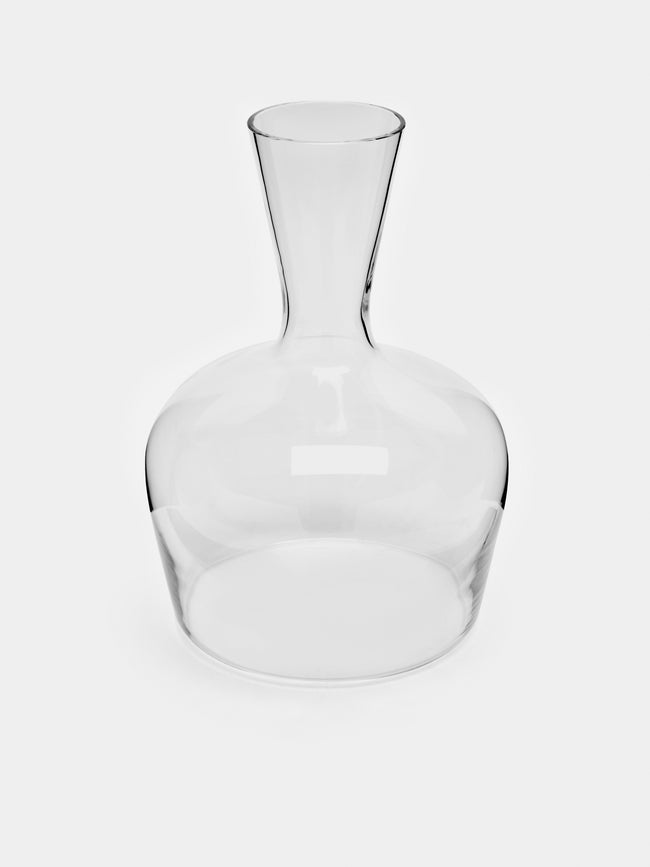
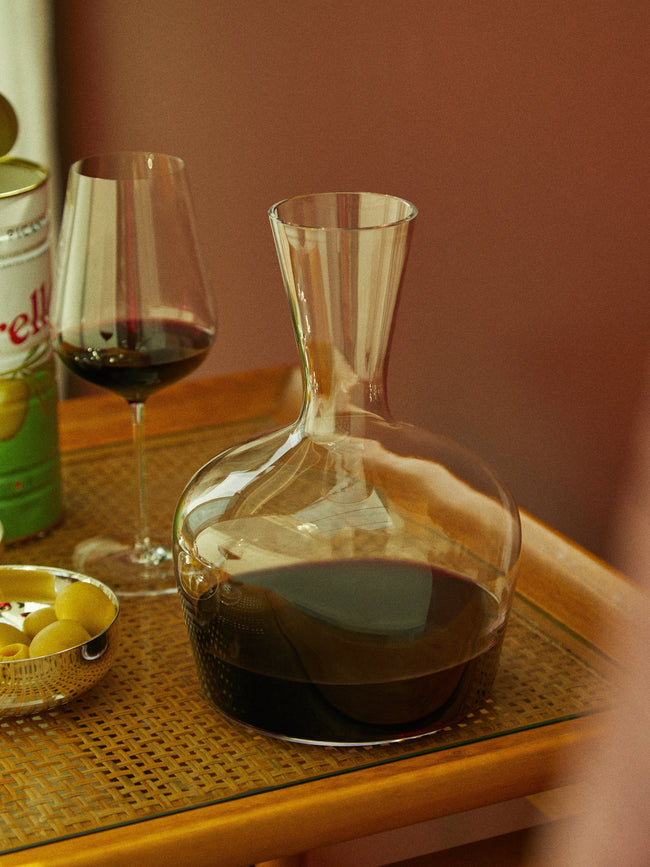
Richard Brendon Young Hand-Blown Crystal Wine Decanter
US$148


What was the design process like for your recent collaboration with Douglas Friedman?
“I'd describe it as a conversation that ebbs and flows the same way that Douglas does. Douglas has a personality that's rare and inspiring, and that's why people find him so intriguing as a human being. I've known him forever and he has this thing about him that makes you want to come back for more. That's not to say that he's consistently always the same person, or predictable; quite the opposite, in fact. Douglas is a really dynamic, effervescent character who lights up the room. His look is very singular, and the culmination of all these things is exactly what his house is. It was super easy to do because there were choices that felt very Douglas—and then additional selections that felt very Douglas that he didn't think felt very Douglas! I explained to him that in order to reflect the kind of personality he is, it had to have contrast, a mix of the odd and slightly off; it was these elements combined that gave it his spirit.”
Is there ever a world in which you get involved at the stage of helping people decide where to buy?
“It’s brought up a lot. One of the things that’s been fun about living in different places is watching people react to a location, and get inspired to say, ‘Wait, maybe this is a place that I want to be.’ I get excited about helping people establish the essence of what they’re looking for, from where they have chosen to settle—for example, if I lived in Charleston, how would I live? What kind of house would I live in? Is it compelling? what is the narrative?”


Mervyn Gers Ceramics | Set of 2 | Hand-Glazed Ceramic Lidded Pots
US$410


Mori Kougei Poke Morado Wood Square Tray (10.5in/26.5cm)
US$390


Has that changed much over the course of your career?
“I think after COVID, people craved change, and it was interesting to discuss how one might live more outside the city. Sometimes single friends would say, ‘I really think it would be fun to buy a house in Connecticut, since the Hamptons have become so crowded, and it’s so hard to get there,’ and we’d have this compelling conversation about the beauty of a great house in Connecticut, but also how lonely it could be, vs the strong social community on the East End.
Then there are people in the Hamptons who crave a certain region because they pay lots of money to be there. They are surrounded by house after house of 19th-century architecture, and yet they build a glass Modernist box. And I ponder, ‘Remind me again what you like about this place, because you’ve created nothing that has anything to do with the 300 years of lessons that have been provided to you?!’ It’s like being an English teacher and writing in Spanish. It’s great, but it’s a different narrative.”
Steven Gambrel


How do you approach collaboration?
“I’m really, really, really keen on learning from others and giving people a semblance of what they’re asking for, even if it’s not necessarily my taste. Something intriguing and really cool about what I do is my ability to read desires. It’s a little like being a set designer and trying to create a background for a movie. It certainly wouldn’t be fair to change the movie—it’s not my movie to change. So, I create an environment after reading the script that feels appropriate not only to the script, but also to the actors, the director, and the producer.”
How far were you into your career when you started to notice these signatures coming through? Or have you always remained steadfast to a set of principles and way of doing things?
“I’m not trying to pat myself on the back, I just find this curious; I got a phone call two days ago from a client I worked with 22 years ago. She said a guest had just left saying how beautiful the house is and how fresh and relevant it still feels. She said, ‘I told the person I haven’t touched it in 22 years. We haven’t made any changes, just maintenance. She said, “I wanted to call you to thank you and tell you how many amazing experiences we’ve had here and that we raised a family here.
I’m really intrigued by how much my work remains relevant, regardless of how many years pass, and I think that’s probably due to being careful about learning from the environment, learning from the person who lives there and their lifestyle, and taking all sorts of good things from the past without being beholden to a certain period, which I think would date the project.”


Where do you stand on heirlooms?
“What I find challenging about modern-day heirlooms—meaning the things you and I might inherit from our grandmother—is that you're looking at something potentially out of place. In my family, we have 18th-century bed covers that are beautifully handwoven and very special in their way, but there's absolutely positively no way I could use them. I don't want to. Its not that I don’t like them, but I don't want them in my stylish relaxed environments. So now they're beautifully folded in a closet for someone in the future to enjoy.
Heirlooms are only fun if you like them. I have a friend who came from an extremely privileged background, and her father left her a great art collection with a lot of value. She didn’t like the staid equestrian paintings, but in his will, he did an amazing thing and said that the collection could either be kept by his heir or sold, as long as the money was put back into art. He wanted his collection to remain art, meaning that his daughter had an art collection, but it didn't necessarily have to be the same art. I thought that was a remarkable idea.”
How would you describe your own personal interior style?
“It’s strong and clear, not wishy washy, but collected for sure. I like objects and colors with clarity and a point of view. I’m always looking for items that have a beautiful proportion, glaze or patina that makes them special. While a decorator, architect or collector might take those unique items and put them into a white empty room to celebrate their beauty and proportions, that’s not me. I prefer to put them into an environment that already has architectural clarity, proportion, and lots of detail.
My ‘empty’ rooms are already on their way to being resolved before any objects go in, meaning they have wax plaster ceilings or are layered in encaustic plaster or lime wash. The trim is usually a deeper tone to frame the corners, the doors are often dark to frame the openings, and the hardware is always custom. I wouldn’t be satisfied if the hardware wasn't perfect because you can’t work around that. The lighting is also very considered, as I don't rely on recessed lights or anything that isn't purposeful. I have lighting that's been designed in the rooms to do what’s important, which is to circulate the light and the warmth all the way around the room, without overlighting any singular surface.
By the time the furniture and objects arrive, that background is already well established and these singular pieces are no longer singular, they become part of a bigger story. That's what I try to achieve.”
Are there particular craft or design objects that you're most drawn to for these rooms?
“Danish bronzes have a great patina to them and there are makers of the 20th century where the patina is so beautiful that it's hard to pass them up. There are porcelain makers like Royal Copenhagen where I’m mesmerized by the quality of the glaze and the bronze work. Those are pieces that I collect, given the opportunity. Mixed with that, there might be just beautiful things that are found at flea markets and sales. It wouldn't matter to me whether it was important or cracked or made by [an unknown] artist.”
Would you say that you like finding the imperfections in things? Does that tell a story to you?
“Oh yes. I like when an imperfection is absorbed into something so it isn’t necessarily an imperfection. I don't even think about it until a client comes along and they're not that type of person—and that's fine too. It's like meeting a non-dog person, it’s kind of shocking, but it’s not a problem. I usually say, ‘What's your level of tolerance for patina and age? I just need to know as that’s extremely important going into a project.”


Who or what are you most inspired to when it comes to design?
“When I meet an artist creating something that feels very much ‘them’. It’s not because I’m looking for something that I’ve never seen before; it’s more about authenticity. I prefer if it doesn’t feel derivative or like a replica or reproduction. The spin that someone puts on something makes it theirs and it’s their contribution to history.”
What's on your design radar right now, Steven?
“At the moment, Vienna. I love it there, but haven’t been in a while. Viennese Secessionism is a period that’s very hard to use because it’s so singular, but you can learn lessons from an environment like that. I don’t want to fall into an ‘ism,’ but I’m intrigued by how it still exists as such a powerful movement, and why it’s so hard to draw from it without it becoming too obvious. The derivative of Georgian is easy, it somehow always feels okay, but the derivative of Secessionism would feel like I was falling into a trap or a time machine. I look forward to digging a little deeper by seeing some of the works from makers who inspire me, learn more about how they were made, and dig into the archives. To me, that would be really compelling.”

Is there an item that you're particularly attached to?
“I wish I could tell you that I'm not sentimental or that I don’t care about material things, but I do love certain objects for what they are—those that have soul and character and make me feel grounded. There are pieces that have stayed with me for years that I could never imagine parting with. There's an Empire chair I bought when I was at the University of Virginia at a junk shop. I think it was $300, which was probably a lot when I was in college. I always loved it, I had it in my dorm room, and now it's in my beach house.”
Are you happy you kept it?
“I was looking at it this week, thinking how funny it is that I found a piece like that in 1990 in a barn in Virginia, so lean and edited and handsome and well-proportioned —and how it’s been with me ever since. It is still a perfect example of a period, but there’s also something about it that isn’t typical of the period, where they usually over embellished things and made them fussy, which is where you lose me. But I will confess, that had it have been something I bought, and over the years thought was fussy and poorly proportioned, I would have gotten rid of it. So, I’m not sentimental unless it’s good.”
Would you track your passion for antique hunting and thrifting back to that chair or were you already into it before university?
“Oh yes. When I was a kid, I was really into exploring old houses and trespassing. My dad was very supportive of my endeavors, so we would trespass together. It was a time of change in Virginia when a lot of great buildings were being demolished, and I was super intrigued by what was being taken away. I was very aware of what was good and what was important. In retrospect, had I been somehow an authority in preservation at six years old, I could have saved a lot of things that were incredibly important and were destroyed, probably because of some greedy developer.”
Were your contemporaries doing the same thing at college?
“No. When I had college breaks, I would cajole my parents into taking me to flea markets and antique shows. There were events like Waterford Days, held in a beautiful little 18th-century town in Virginia, where I’d buy cool objects. I loved bottles. I liked the color of the glass and the way they were blown, and I’d collect hand-blown bottles with pale blue and green colors and bubbles. Even back then, I was attracted to the ones that were special.”
Speaking of objects, how would you advise somebody to start building their own collection of home smalls for their homes?
“The environment is a good starting point. If you buy a house in Nantucket, it seems like there should be a level of age and patina that you might abide by to reflect an easy lifestyle reminiscent of that salty island. You’re going to assume that it’s a fun, relaxed, dog-filled world, so think: is the vase big enough for branches, and does it matter if it gets chipped? Things like hotel silver are great because you can drop them and it doesn’t matter; if they get dented, they look better. I’d hate to have a beach house or a cabin in the woods that held you back from feeling super relaxed and part of nature, as you want to encourage people to enjoy their environment; collect accordingly.
Whereas, if you were living in a more urbane environment like in the city, you could utilize more refined elements—things that are more delicate, allow light to come through, and feel more elegant. Objects that might be easier to understand in a setting where you don’t have the threat of the great outdoors. Objects that might incite good behavior, to some degree at least.”
Do you think your clients look to you for the courage—permission, perhaps—to go in their own direction and not be dictated to by the past?
“Absolutely. I like the fact that when you leave a place, you'll likely leave things behind. Not necessarily because you're craving change, but because it would be a shame if everywhere led you to the same conclusion. If that were the case, you would probably never move and the world would become very static. When a certain style becomes universal, it doesn't make sense, because how can one style be so prevalent in such different environments? What's wonderful about travel or having a place to go at a different time of the year, is that the experience is supposed to change.
I can't believe that there's a whole world where people want to go to a hotel because they know what to expect. I'm the opposite. When in Charleston, I want to know what hotel has the most flavor of being in Charleston, so I wake up knowing I'm there. You're supposed to wake up and feel the change and feel thrilled to be there.”


Do you get equal amounts of joy from the planning and architecture as you do collecting objects?
“I do. Depending on the day, there’s nothing more exciting than drawing and coming up with ideas, and creating these large design boards that have all these materials on them, whether it’s a hinge or a piece of cloth. There’s something very, very satisfying about going to the office and coming up with something really special. The collecting part is wonderful and, of course, I love to travel. I love the whole process of it all.”
Can you disconnect from previous projects when sourcing? Your Rolodex must be spinning when you're traveling.
“Imagine, it's so hard during the course of a two-year project to find the things that you really want to make something perfect—but it's like a game, it's like a challenge—a competition of one. Sometimes I think, ‘that's close to perfect for the project, but it's not exactly perfect, but maybe it's perfect enough because we've got to get this thing done and you got to move on’. Then two years passes and you're at a store in the middle of nowhere and you see a pair of blue glass lamps and you think, ‘oh, but those are what I wanted for that house! That's what I wanted!’ Sometimes I will take a picture and send it to client, but usually when a project has been indented, it's done.”
Any top tips for treasure hunting?
“One of the things I do which is very helpful is to walk through the market with one project in mind, find great things and document them. Then stop and start over with a different project in mind. That way, you're focused on one singular mission. Obviously, along the way, if I see something special, I'm not going to pass it up because I was thinking about a beach house in lieu of an urban duplex. I’m also looking for things to throw me off—something that I know will work but it’s not something that everyone sees immediately. It's like cooking with ingredients but not from a recipe, by taste. Going by taste is a craft and it's a craft that some people have, and some people don't.”


Your Shopping Bag is currently empty